Half of Change Initiatives Fail
Gartner published research in 2020 that gets quoted often enough that the numbers will sound familiar. Organizations averaged five major firm-wide changes in the past three years. About 75 percent expected the rate to increase. About half of change initiatives fail outright. About 34 percent report success. The remaining 16 percent are mixed.
Half is not a comforting number. It also is not, on its own, useful. The interesting question is not what the failure rate is. The interesting question is why a change fails.
In my experience the failures rarely come from a missing tool or a missing plan. They come from a missing alignment between what leadership believes is going to happen and what the team believes is going to happen. The plan can be flawless on paper. If the team has concluded the change will not stick, the plan does not save it.
The University of Chicago Study
A 2017 study from the University of Chicago looked at how belief shapes outcomes during organizational change. The headline finding is one I have watched play out in conference rooms over and over. If people believe a change will fail, any setback becomes proof of ultimate failure. Teams disengage. The prophecy fulfills itself.
The reverse is also true. People who believe a change will succeed treat setbacks as ordinary friction, not as evidence. They keep showing up. They problem-solve. They protect each other when the plan hits a rough week.
The study did not say belief is the only thing that matters. It said belief is a thing that matters, and the thing leaders most often forget to manage.
The 31 Percent Gap That Shrinks to 3 Percent
A second number worth holding next to the first. Top-down change strategies, the kind where leadership decides and announces, produce an average understanding gap of 31 percent between the C-suite and entry-level employees. Open-source change strategies, the kind that involve the people doing the work in shaping the change, shrink the gap to 3 percent.
A 31 percent gap is not a communication problem. It is a belief problem.
The C-suite believes the work is on track. The team believes the work is wandering. They are looking at the same change. They are reaching different conclusions because they are working from different inputs.
A 3 percent gap is a different organization. Not a different plan. The same plan, run with people who were closer to the shaping of it, lands differently because the team's belief and the leadership's belief are about the same thing.
The Admission That Taught Me the Most
When I first tried to implement accessibility at State Farm, the change did not take.
I had a plan. The plan was technically sound. The teams I had access to could see the work I was asking for. None of that was the issue. The issue was that I had built the plan for the wrong layer of the organization.
What I figured out, slowly, is that people pay attention to what they are measured on. Accessibility was not part of the culture, the goals, or the measurement system at State Farm. It was an ask sitting outside the structure that decided what mattered. The teams were not refusing to do the work. They had concluded, correctly, that nobody was looking, and that the program would not last past the next reorganization. They were right to disengage. From where they sat, my plan was a flavor of the month.
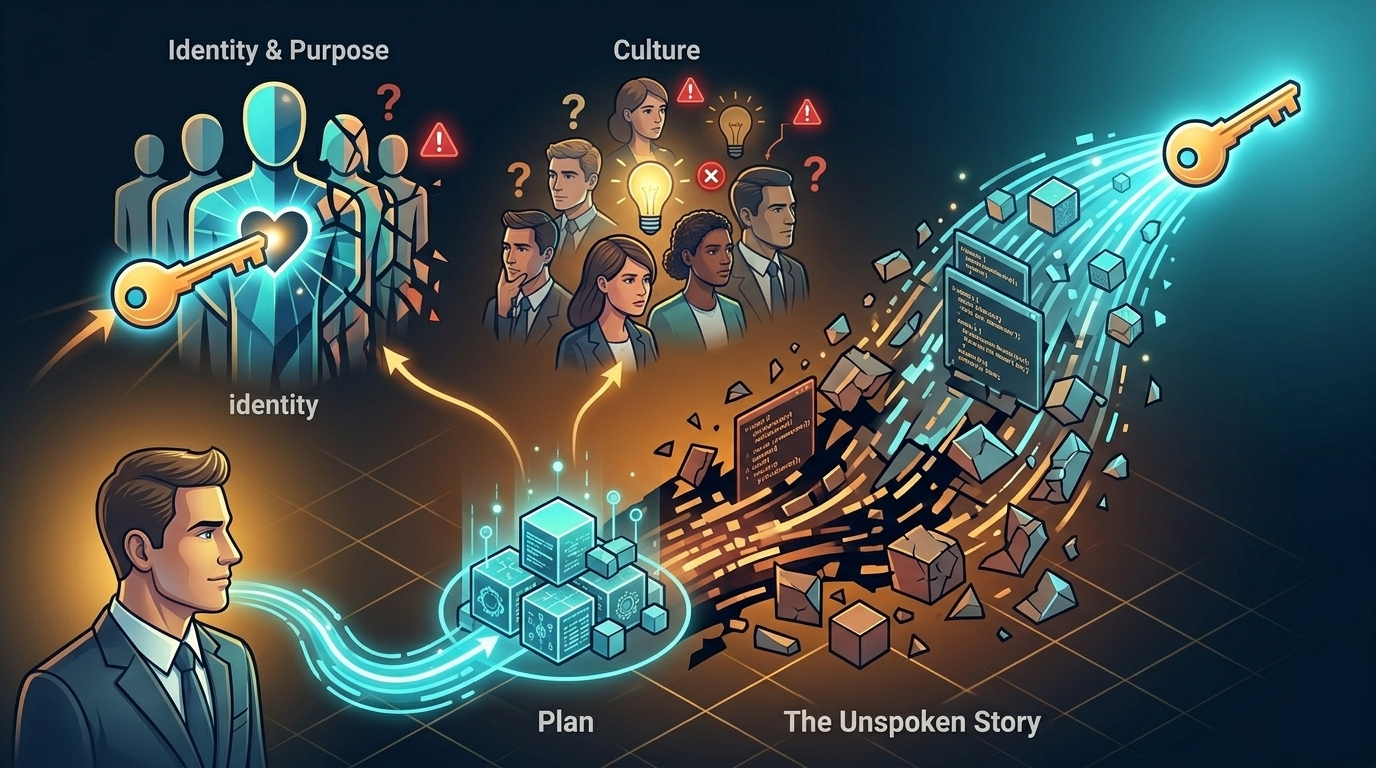
The framework that helped me see this was Stanford's Strategic Execution Framework (SEF). SEF maps an organization as a set of overlapping domains, not a flat stack of layers. The upper domains hold the things that decide what matters: identity, purpose, culture, structure, goals, and metrics. The lower domains hold the things that execute on what was decided: portfolio, programs, projects, and operations. The flow runs from the upper domains down. If a change is named in the upper domains, the lower ones rearrange around it. The organization makes room for the change. If the change is inserted only at the portfolio or project level, the upper domains have not moved, and the organization treats the change as something that has not really been decided yet.
The fix that worked was not a better tool or a louder rollout. It was going back to the goals and the culture and trying to get accessibility named at the level where the organization actually decides what matters. That was not a paragraph of work. I had to convince a product owner. I had to keep telling the story over and over. The organization believed accessibility was a nice to have with no ROI. They were wrong on both counts. Accessibility is part of building products for the people who use them, and the ROI is real. Pushing back on what they had already concluded was the work. Some weeks felt like three steps forward and two steps back. I reminded myself in those weeks that one step is still progress.
What landed was narrower than I would like. The change took hold in one or two teams in claims. Another team did the multi-year work of taking it broader at State Farm, and that work was not mine. I do not know if a legacy was left in the teams I worked with. I do not know if they backslid after I moved on. I was passionate about it. I do not know if anybody else carried the same passion forward.
The plan finally pointed at the right layer, and that mattered. It just did not finish the work. Pointing at the right layer gets the work into the room where it can take hold. The taking hold is its own multi-year fight.
Where to Start Instead
Most change advice starts with the plan. I would start one step before that.
Start by closing the gap between what leadership believes about the change and what the team believes about it. Talk to people who do the work. Ask what they think is going to happen. Listen for the gap. The gap is the data.
If the gap is awareness, fix it with information. Most gaps are not awareness. Most gaps are desire (the team has heard the message and decided not to act yet) or ability (the team is willing but the path is blocked). Each requires a different response.
Once the gap is closed enough that the team and the leaders are looking at the same change, the plan can do its job. Until then, the plan is a placeholder, and the change is failing already.
Takeaway: If you are about to launch a change, do not start with the plan. Start with the gap. Find out what the team believes is about to happen, and compare it to what you believe. The size of that gap is a better predictor of success than the quality of the plan. Close the gap. Then run the plan.
How this insight supports different learners
R Readers
See belief as a variable to manage, not as a feeling that happens to your team.
L Listeners
Recognize the moment when a team has quietly concluded a change is going to fail.
D Doers
Run a one-question survey before your next change kickoff. Ask the team if they think it will work. Treat the answer as the first item on your plan.
O Observers
Watch a leader skip the belief step and see what happens.
Questions this insight answers
- Why do so many change initiatives fail?
- What is the role of belief in delivery?
- How do I tell whether a team believes in a change?
- What do I do before I write the change plan?
- Why does my change feel stuck before it has started?