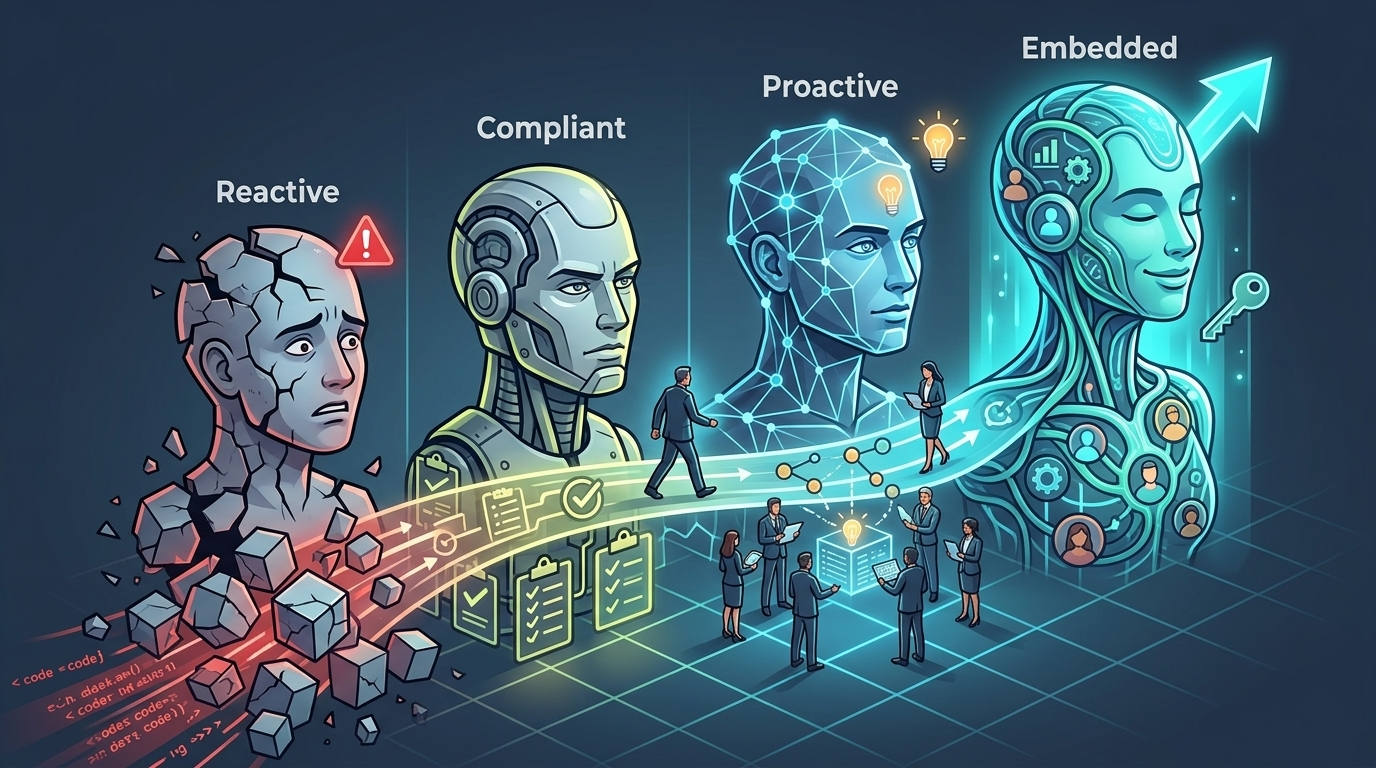
The Four-Stage Maturity Model
A useful way to diagnose where a team is on accessibility is a four-stage progression, similar to maturity models you would see in any quality discipline.
Reactive
Fixes happen after launch. There is no formal owner. Someone files a complaint or a bug, somebody patches it, and the cycle repeats. The work is real but the work is invisible to leadership.
Compliant
An audit drives the work. There is a checklist mentality. Teams meet WCAG enough to pass an audit and then stop. Accessibility is treated as a one-time event, not a habit. The team gets through the audit and waits for the next one.
Proactive
A dedicated team exists. Standards and training exist. People know who owns what. The work is no longer event-driven. It is part of how the team works, even if it still feels separate from the rest of the product.
Embedded
Everyone owns it. Accessibility shows up in design reviews, in performance reviews, in roadmap decisions. The team uses accessibility as a way to drive product innovation, not as a tax to be paid.
You do not skip stages. A reactive team cannot become embedded by buying a tool. The leadership work between each stage is what moves the organization forward, and that work takes time you cannot compress.
Two Public Examples: Apple and Microsoft, and the Companies Who Got Sued
The clearest public examples of accessibility at the embedded stage are Apple and Microsoft. Both companies have spent years moving through the maturity stages, and both have published enough about that work that you can study it from the outside.
Apple builds accessibility into the operating system at every level. VoiceOver, Switch Control, AssistiveTouch, and the rest of the accessibility features are not bolted on. They ship with every device. Apple's product keynotes regularly feature accessibility users. The Designed for campaigns put real customers at the center of the marketing. Accessibility is not a separate workstream. It is part of how the product gets made.
Microsoft has done the same kind of work from a different starting point. The Inclusive Design toolkit Microsoft published is now used across the industry. The Xbox Adaptive Controller is a hero product, not a niche accessory. Satya Nadella has spoken publicly about accessibility's place in the company's mission. Accessibility leaders inside Microsoft have public profiles. The work shows up at the executive level and in the org chart.
Neither company got there by buying a tool. Neither got there by running a one-time audit. Both got there because leadership decided accessibility was part of the company they were trying to be, and they kept making decisions that matched that decision over years.
Compare that to the companies that show up in court records for the same topic. Domino's lost an accessibility case in federal appeals court, and the Supreme Court declined to hear the appeal. Target settled with the National Federation of the Blind years before that. Airlines, retailers, and a long list of websites have paid for ADA Title III remediation after a complaint or a lawsuit. Those companies sat at the reactive stage. The lawsuit drove the work. The work was treated as a one-time fix. The next product launch started the cycle over because nothing structural moved.
The difference between the two groups is leadership. The companies that move through the stages are led by people who decide accessibility is part of the work. The companies that stay reactive are led by people who decide it is not, and the law decides for them later.
ADKAR Mapped to the Objections You Will Hear
When you start trying to move an organization through these stages, you will hear the same objections over and over. Prosci's ADKAR model gives you a way to diagnose what is actually behind the objection so you can pick a useful response.
ADKAR stands for Awareness, Desire, Knowledge, Ability, and Reinforcement. Each objection maps cleanly to a gap.
"We don't have time or budget."
That is a Desire gap. The team knows the work matters. They have not been given a reason to want it more than the other thing on their plate.
"It's too complicated."
That is a Knowledge gap. The team is not sure what good looks like.
"That's not my job."
That can be Awareness or Desire, depending on tone. If they truly do not know it could be their job, it is awareness. If they know and would prefer it stay somebody else's, it is desire.
"Our users don't need it."
That is an Awareness gap. The team has not seen the data, has not met a user, has not connected the dots between accessibility and their actual customer base.
"Our platform doesn't support it."
That can be Knowledge or Ability. They may not know how to do it on the platform they have, or the platform may genuinely lack the capability and they need a different tool.
"We'll fix it later."
That is a Desire gap. They believe the work matters, just not yet.
The point is not that ADKAR is the right framework or the only framework. The point is that the response to "we don't have time" looks completely different from the response to "it's too complicated." Picking the right response requires diagnosing the gap first.
Diagnose Before You Prescribe
Most accessibility work that stalls is not stalled because the team is unaware. Awareness is usually the cheapest thing to fix. A talk, an article, a story about a real user is enough.
Most stuck accessibility work is stuck at desire or ability. Desire means the team has heard the message and decided not to act yet. Ability means the team is willing but cannot get the work done with the tools or skills or time they have. Both are different problems, and both require leadership moves that look different from the awareness move.
Desire problems get solved by tying the work to something the leader cares about already. Risk. Customer retention. Brand. Hiring. The conversation is not "should we do accessibility." The conversation is "here is the thing you already care about, and accessibility is part of it."
Ability problems get solved by clearing the path. Better tools. Training that fits the role. Time on the calendar to learn. Pairing with somebody who has done it before. The conversation is: you are willing to do this. Let me make it possible.
Most stalled accessibility work is stuck at Desire or Ability, not Awareness. Diagnose the gap before prescribing the response.
If a leader keeps prescribing more awareness on top of a desire or ability problem, the team gets numb. They have heard the talk. They want the path cleared.
The Leader's Part of the Job
Most of the work described above sits with leaders. Not because individual contributors do not matter. They matter enormously. The reason it sits with leaders is that the things that move the organization between stages, sponsorship, budget, performance review criteria, hiring, the roadmap conversation, are leadership-shaped.
Checklists do not change cultures. Leaders do.
The leader's part of the job, on accessibility, is the same as the leader's part on any quality attribute. Decide it matters. Fund it. Tie it to metrics the team already uses. Make it visible at the top. Hire and promote based on it. Talk about it more than once. The team will fill in the rest.
If your accessibility work feels stuck, find your stage on the maturity model and figure out which gap is in the way. Awareness is usually not the answer. The answer is almost always desire (give the team a reason that connects to what already matters) or ability (clear the path). The maturity stages move at the speed of leadership attention, not at the speed of audits.
How this insight supports different learners
R Readers
See accessibility as a leadership problem with a maturity arc, not as a compliance event.
L Listeners
Recognize the objections you have already heard and what they actually mean.
D Doers
Pick one stage of the model your organization is in, and one gap to address, and run a small experiment for ninety days.
O Observers
Watch what happens when leadership treats accessibility like security versus like a checklist.
Questions this insight answers
- Why does our accessibility work keep stalling?
- What stage are we actually at?
- Which objections matter and which are noise?
- How do we move from compliant to embedded?
- What is leadership's part in this?